Toprak Lab

Antibiotic resistance is easiest to understand when you can watch it happen. The morbidostat is a feedback-controlled continuous culture device that keeps bacteria near a constant level of growth inhibition by automatically adjusting drug concentration in real time. This turns evolution into a quantitative time series: we can measure trajectories, compare replicates, and connect phenotypes to the mutations that drive them.

Protocol

Building a morbidostat: an automated continuous-culture device for studying bacterial drug resistance under dynamically sustained drug inhibition

E. Toprak*, A. Veres, S. Yıldız, J.M. Pedraza, R. Chait, J. Paulsson & R. Kishony*

Nature Protocols 8, 555–585 (2013)

View on Nature.com Download PDF

Real-Time Observation of Resistance Evolution

Even when outcomes look similar, the underlying genetic routes can be surprisingly structured.
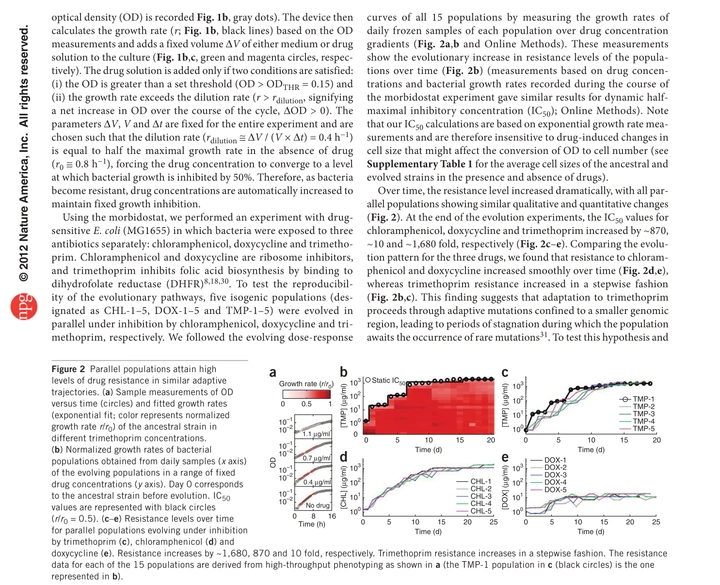
Resistance trajectories showing parallel populations evolving under chloramphenicol, doxycycline, and trimethoprim — stepwise vs smooth IC50 increases and normalized growth rate heatmaps
Evolution has tempos. Five replicate E. coli populations evolved under chloramphenicol, doxycycline, and trimethoprim reach high resistance—but with distinct dynamics. Trimethoprim often rises in discrete steps (few large-effect mutations), while the others can increase more smoothly (many routes with smaller increments). Toprak, Veres, Michel et al., Nature Genetics (2012)
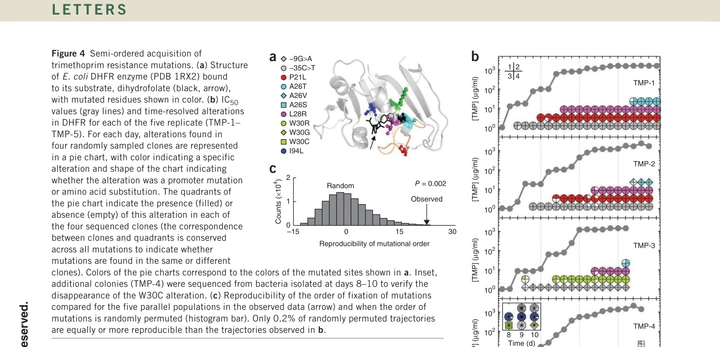
DHFR crystal structure with color-coded resistance mutations, temporal pie charts tracking mutation fixation across 5 populations, and statistical reproducibility analysis
Semi-ordered genetic paths. Whole-genome sequencing shows that the same DHFR mutations arise independently across replicate populations and often fix in a similar order. Resistance evolution is not fully predictable—but it is far from arbitrary. Toprak, Veres, Michel et al., Nature Genetics (2012)
Nature Genetics 2012

Evolutionary paths to antibiotic resistance under dynamically sustained drug selection

E. Toprak, A. Veres, J.B. Michel, R. Chait, D.L. Hartl, R. Kishony

Nature Genetics 44, 101–105 (2012)

The original morbidostat experiments tracked E. coli evolving resistance to multiple antibiotics under dynamically sustained inhibition. Replicate populations repeatedly discovered similar solutions, and sequencing revealed semi-ordered mutational trajectories—a foundation for thinking about resistance as a constrained, measurable process.

View Article

Selection Strength Shapes Evolutionary Complexity

Selection strength is a dial: it changes which routes appear, and what they cost.
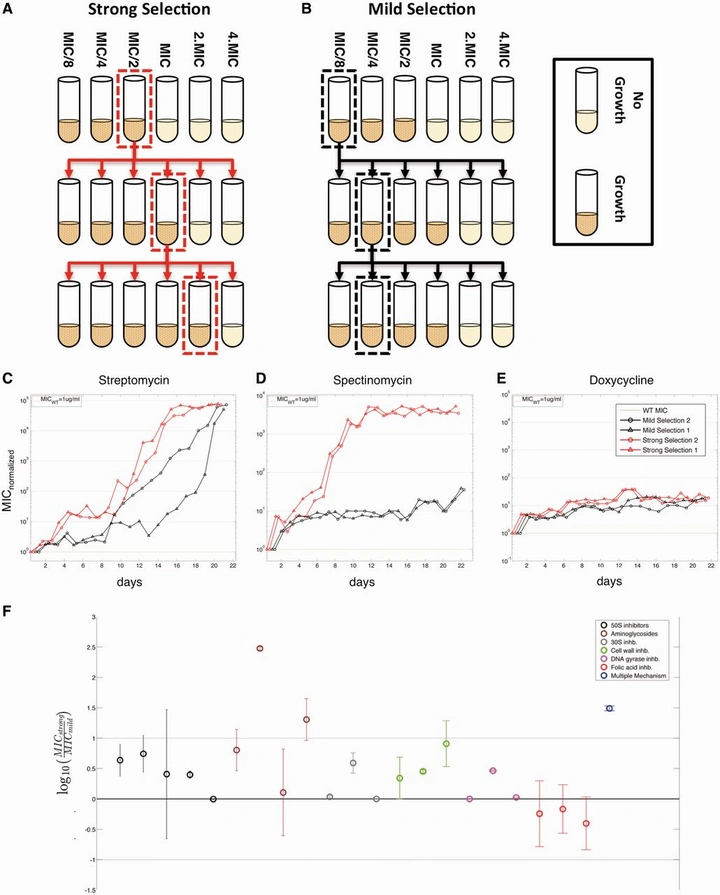
Experimental design comparing strong vs mild antibiotic selection in the morbidostat, with temporal resistance curves for streptomycin, spectinomycin, and doxycycline
Same endpoint, different journeys. Across 88 populations and 22 drugs, strong and mild selection can reach similar final resistance levels—but the dynamics differ. Strong selection drives faster early adaptation, while mild selection proceeds more gradually, sampling different genetic routes along the way. Oz, Guvenek, Yıldız et al., Molecular Biology and Evolution (2014)
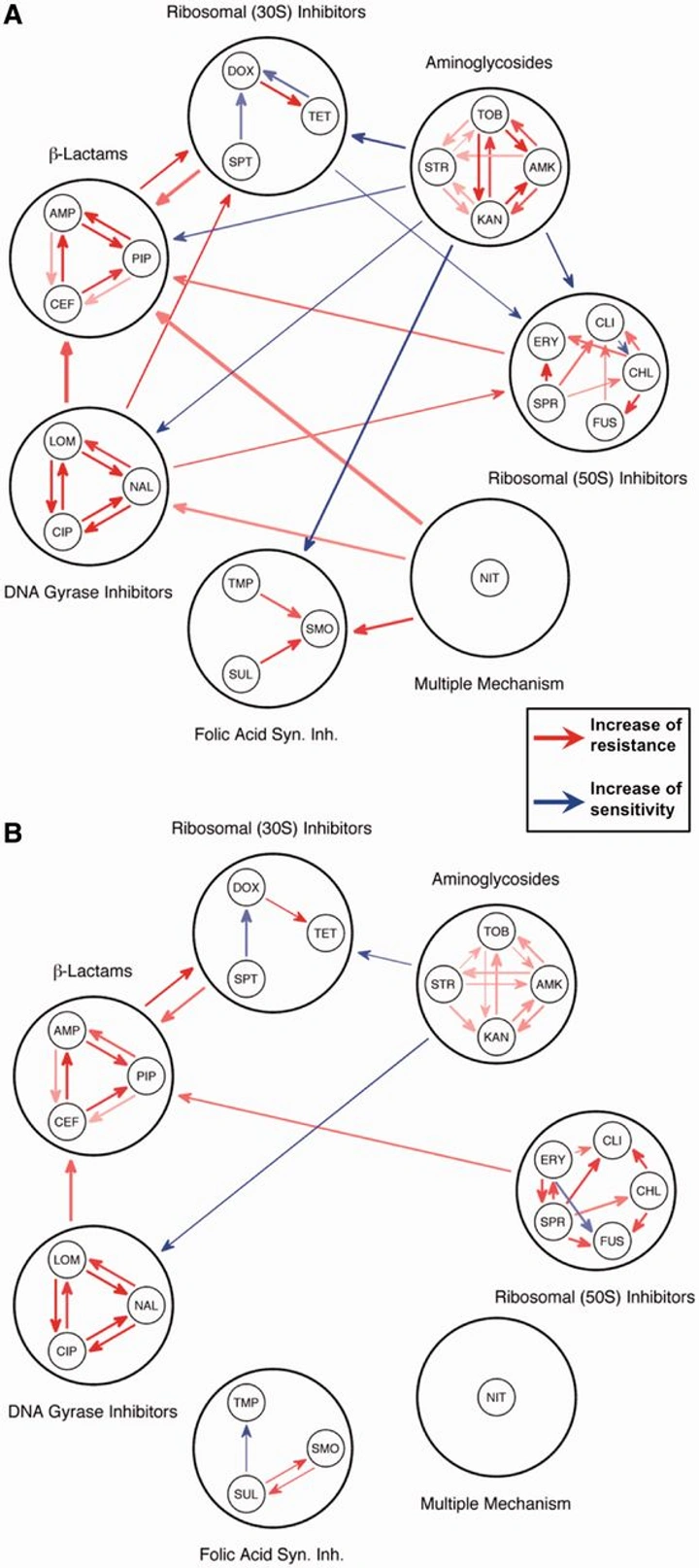
Cross-resistance network diagrams comparing strong vs mild antibiotic selection — denser network under strong selection indicates more pleiotropic effects
Collateral effects proliferate under strong selection. Strong selection produces denser cross-resistance networks than mild selection: strains evolved under intense pressure more often gain collateral resistance (or sensitivity) to other drugs, revealing broad pleiotropic tradeoffs. Oz, Guvenek, Yıldız et al., Molecular Biology and Evolution (2014)
Molecular Biology and Evolution 2014

Strength of selection pressure is an important parameter contributing to the complexity of antibiotic resistance evolution

T. Oz, A. Guvenek, S. Yıldız, E. Karaboga, Y.T. Tamer, N. Mumcuyan, V.B. Ozan, G.H. Senturk, M. Cokol, P. Yeh, E. Toprak

Molecular Biology and Evolution 31(9), 2387–2401 (2014)

By systematically varying selection strength across 88 populations and 22 drugs, this work showed that the intensity of pressure is a key determinant of evolutionary complexity. Similar resistance levels can emerge under strong or mild regimens—but via different genetic routes and with different collateral profiles.

View Article