Toprak Lab

Antibiotic resistance is evolution in a hurry — and it rarely hinges on a single trick. Pathogens can survive by hiding in the host, by taking a few key mutational steps, or by exploring an enormous combinatorial space of enzyme variants. Our goal is to make that search process measurable, so we can predict the paths most likely to appear and design drugs and treatment strategies that close them.

Surviving Without Resistance

Treatment failure can begin with survival—not mutation. We study how susceptible pathogens persist in vivo under clinically grounded drug exposures.
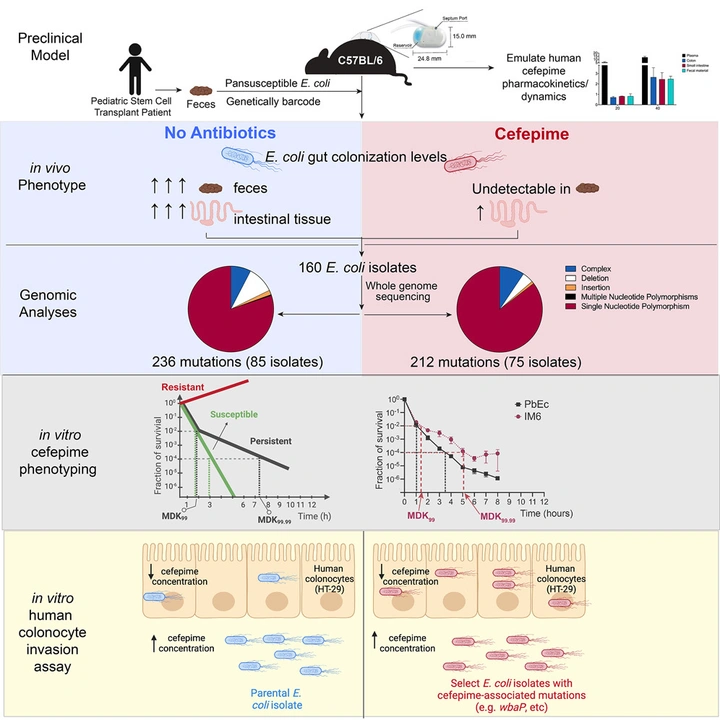
Graphical abstract showing experimental workflow: mouse model with barcoded E. coli, cefepime treatment, genomic analyses of 160 isolates, and in vitro phenotyping revealing persister and cell-invasion phenotypes
A clinically grounded model. A cefepime regimen tuned to human pharmacokinetics is applied to barcoded, patient-derived E. coli colonizing germ-free mice. Surviving lineages are sequenced and phenotyped to separate classical resistance from host-associated escape and persister-like survival.
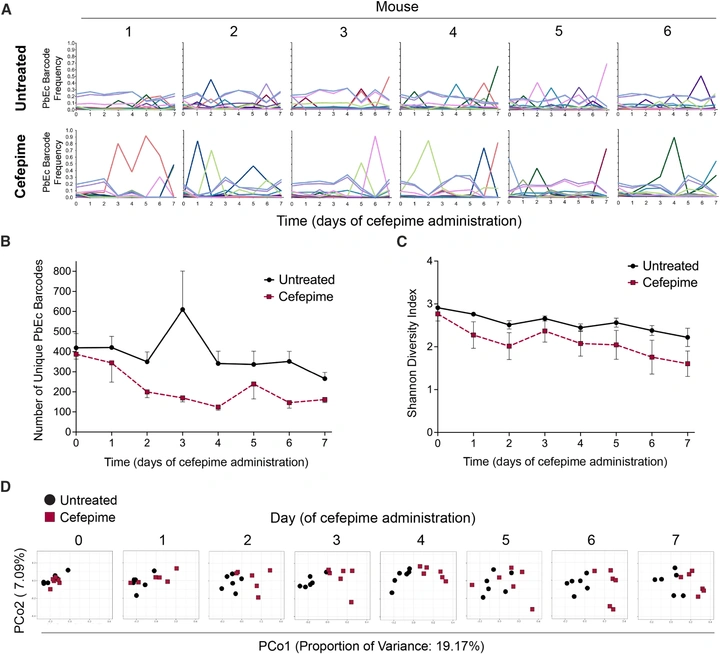
Lineage tracking of barcoded E. coli in untreated and cefepime-treated mice showing clonal dynamics, barcode diversity decline, and population bottlenecks
A bottleneck you can count. Under cefepime, barcode diversity collapses and a few clones dominate. This sharp within-host bottleneck emerges without increased MIC, implicating selection on survival strategies (e.g., invasion and persistence) rather than canonical resistance.
Cell Host & Microbe 2024

Susceptible bacteria can survive antibiotic treatment in the mammalian gastrointestinal tract without evolving resistance

Marinelle Rodrigues, Parastoo Sabaeifard, Muhammed Sadık Yıldız, Adam Lyon, Andrew Y. Koh, Erdal Toprak

Cell Host & Microbe (2024)

In a mouse model that emulates human cefepime pharmacokinetics, a pansusceptible clinical E. coli strain disappears from stool yet remains recoverable from intestinal tissue. Survivors do not evolve higher MIC; instead, mutations increase epithelial invasion and/or enable persister-like survival, revealing a non-canonical route to treatment failure.

View Article

Steering Evolution with Drug Design

Use molecular mechanism to turn evolution’s favorite shortcut into a dead end.
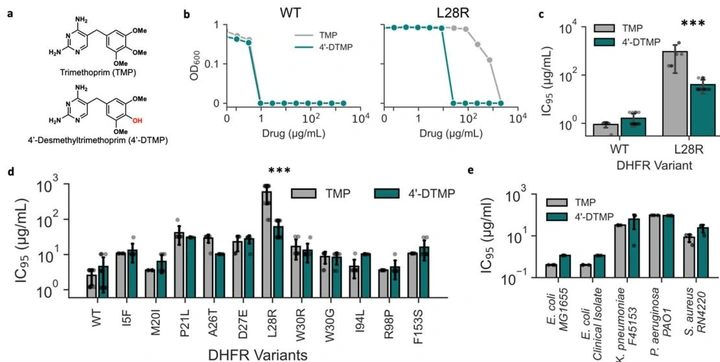
Chemical structures of TMP and 4'-DTMP with dose-response curves showing 30-fold enhanced selective activity of 4'-DTMP against L28R DHFR mutants
Hitting the usual suspect. Trimethoprim resistance often begins with a single DHFR mutation (L28R). 4’-DTMP retains potency against both wild-type DHFR and L28R, sharply reducing the advantage of that first step.
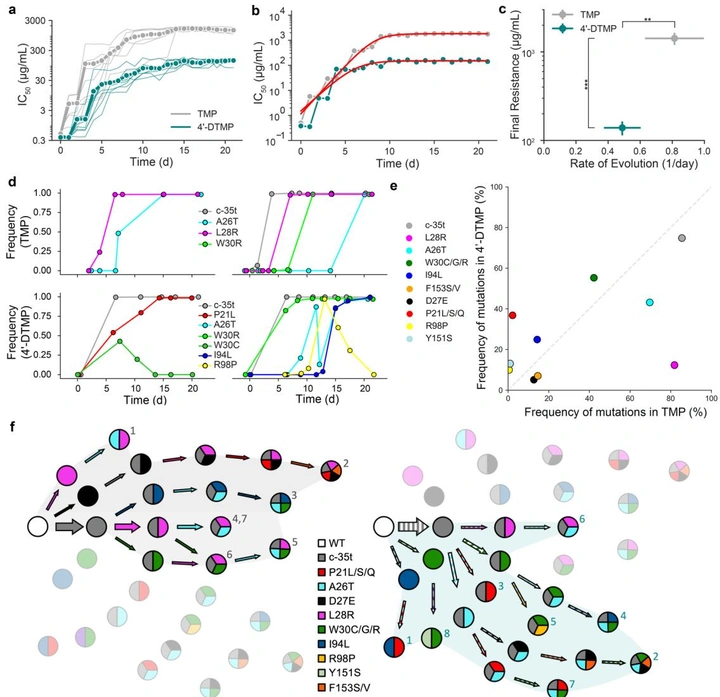
Morbidostat IC50 trajectories comparing TMP and 4'-DTMP evolution rates, mutation frequency tracking, and evolutionary pathway Sankey diagrams
Rerouting trajectories in real time. In morbidostat evolutions, 4’-DTMP suppresses the L28R route and slows the rise of resistance, diverting populations toward alternative DHFR solutions with higher fitness costs.
Adaptive seascape of DHFR resistance. As trimethoprim concentration increases, the fitness landscape shifts — each pillar represents a DHFR allele, with height proportional to resistance (IC50). At low drug concentrations many evolutionary routes are viable, but as pressure intensifies only a few peaks remain, funneling populations toward predictable high-resistance genotypes. Tamer, Gaszek, Abdizadeh et al., MBE (2019)
Nature Communications 2021

A trimethoprim derivative impedes antibiotic resistance evolution

Madhu Sudan Manna, Yusuf Talha Tamer, Ilona Gaszek et al.

Nature Communications 12, 3853 (2021)

By dissecting the molecular logic of the canonical DHFR resistance mutation (L28R), we designed 4’-DTMP—an inhibitor that stays potent against L28R. In evolution experiments, 4’-DTMP selects against the usual shortcut and diverts populations to alternative DHFR mutations with catalytic penalties, slowing resistance emergence.

View Article

Deep Mutational Scanning

Combinatorially complete fitness landscapes reveal when resistance is predictable—and when it isn’t.
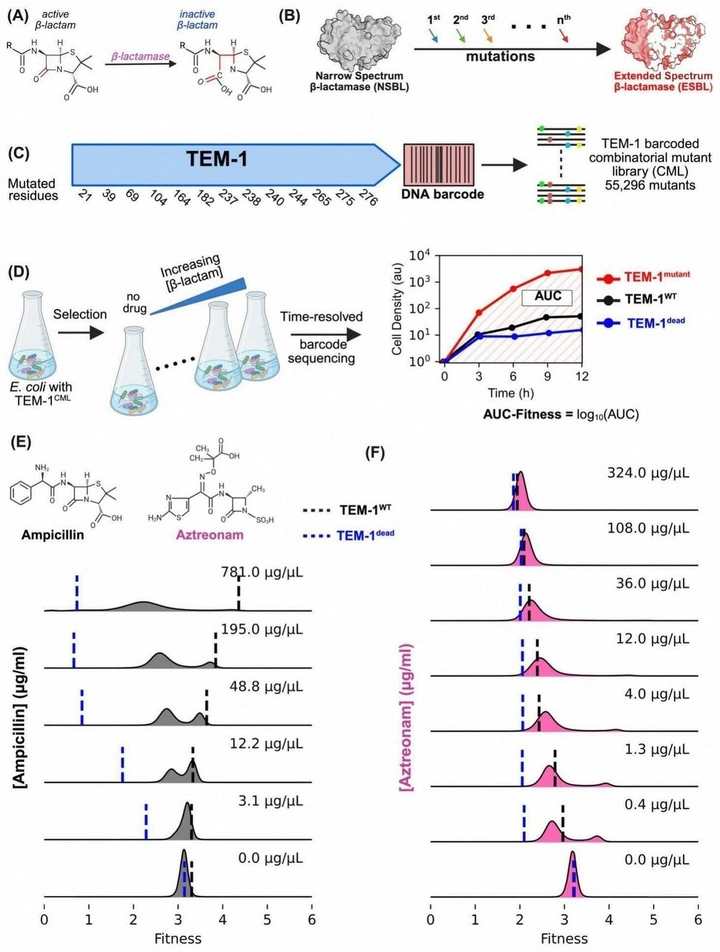
TEM-1 combinatorial mutant library design and fitness landscape under ampicillin and aztreonam selection
A complete map for TEM-1. We built all 55,296 TEM-1 β-lactamase variants spanning 18 clinically observed mutations (13 residues) and measured fitness across drug environments, generating millions of empirical points on a resistance landscape.
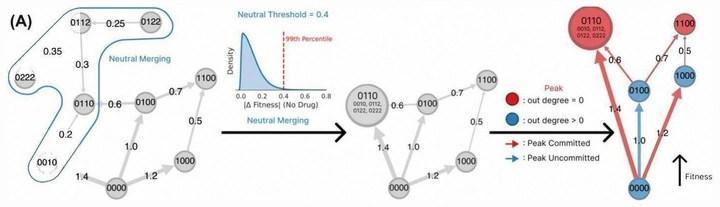
Graph-theoretic fitness landscape showing neutral merging and fitness peaks
Why prediction breaks. Under a novel substrate (aztreonam), higher-order epistasis creates many accessible peaks and branching paths. Graph-based views make this ruggedness explicit—and quantify the inherent unpredictability it produces.
Preprint 2025

Higher-order epistasis drives evolutionary unpredictability toward novel antibiotic resistance

Ilona K. Gaszek, Muhammed Sadık Yıldız et al.

bioRxiv (2025)

Ilona Gaszek and colleagues measured the largest resistance fitness landscape to date: 55,296 TEM-1 variants with >8 million fitness measurements. Adaptation under a native substrate is comparatively smooth, while selection by a novel drug exposes extensive higher-order epistasis and ruggedness—the root of unpredictable evolutionary outcomes.

View on bioRxiv

Sequential Treatment Dynamics

The same drug can select for different solutions depending on what came before.
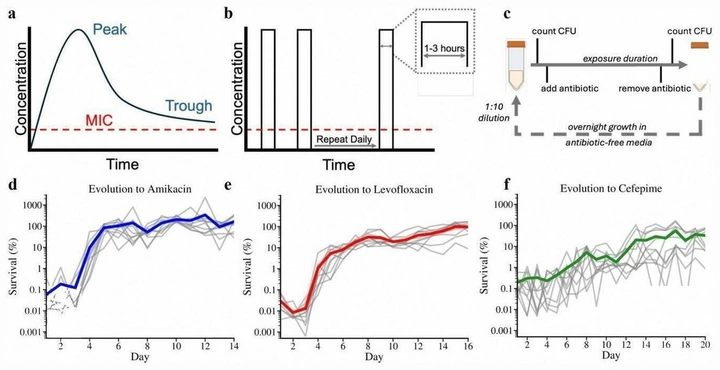
Evolution protocol scheme and survival outcomes during single antibiotic treatment
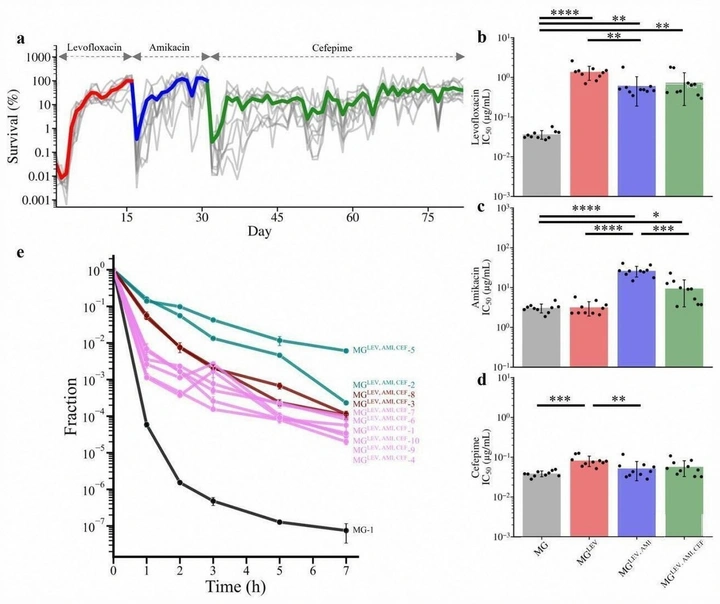
A clinically inspired evolution protocol. We evolve E. coli under high-dose killing while preserving population diversity, then transition cultures between antibiotics to test how history reshapes the path to sustained survival.
Survival and phenotypic outcomes of sequential antibiotic treatment
History-dependent outcomes. Sequential therapy can shift evolutionary trajectories from divergent to convergent routes. Phenotypes may look similar, but the underlying mechanisms—resistance, tolerance, or persistence—and their genetic routes depend on treatment order.
Preprint 2025

Context-dependent evolutionary dynamics toward bacterial survival during sequential antibiotic treatment

A. Lyon, M.S. Yıldız, E. Toprak

bioRxiv (2025)

Sequential antibiotic use can produce reproducible, history-dependent routes to survival. Our protocol exposes antibiotic-specific solutions (resistance, tolerance, persistence) and shows that treatment order can reshape collateral effects and the mutational paths that remain accessible.

View on bioRxiv